Graduate research · 2025
Tornadic tropical cyclone environments
Research focusCan tropical cyclone tornadoes be forecast before landfall using airborne observations?
Research summary
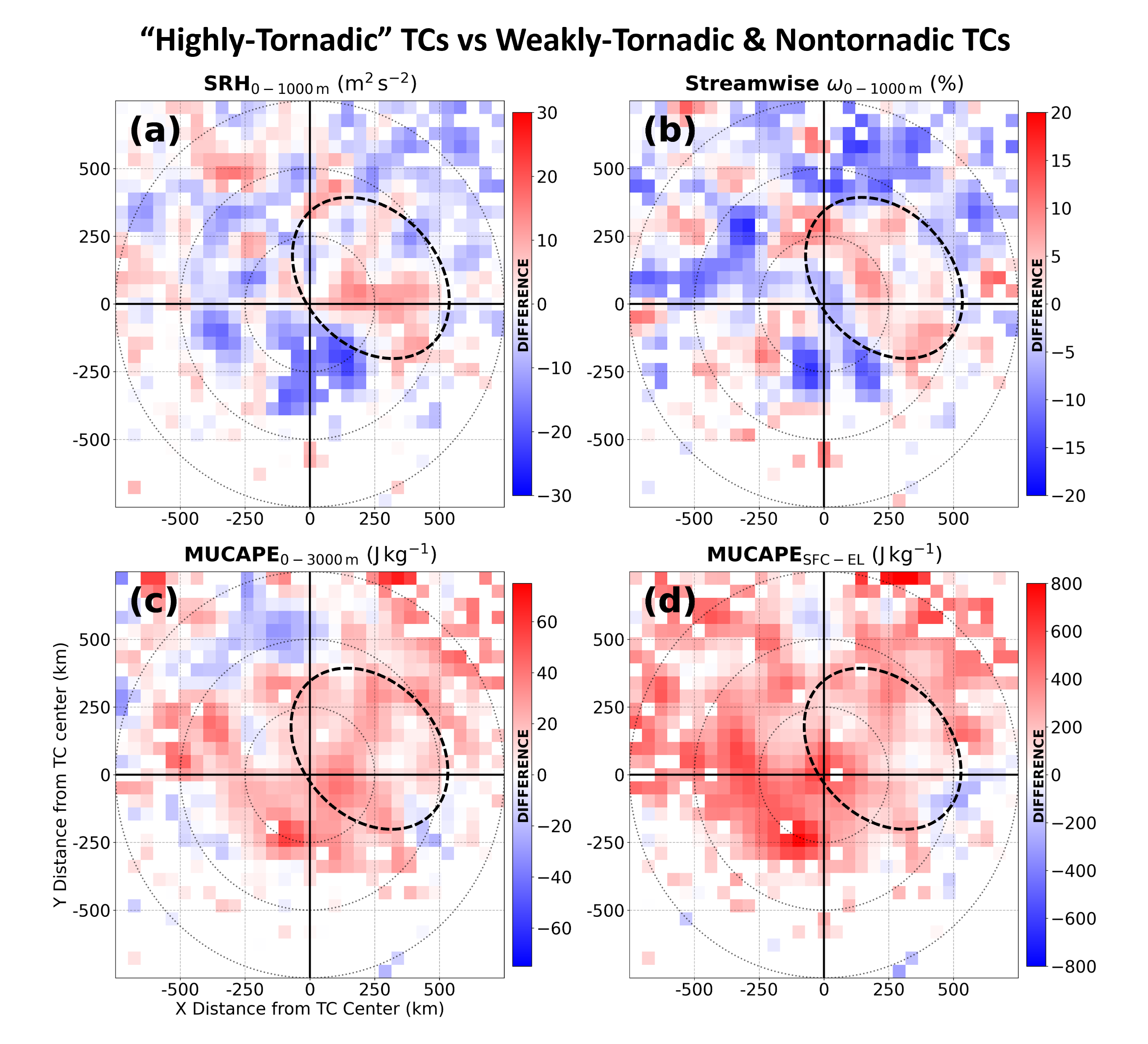
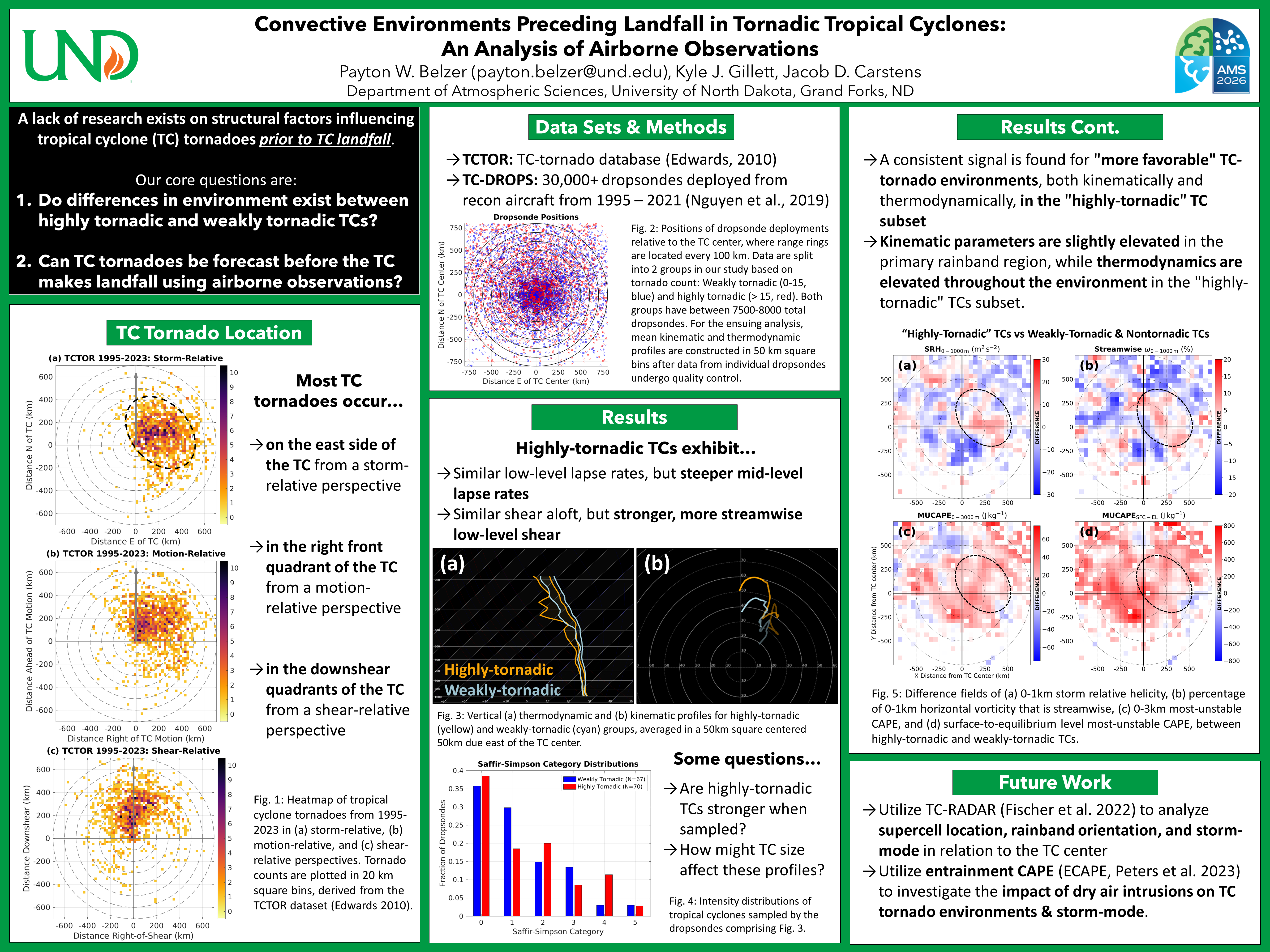
Synopsis: An analysis of ~30,000 dropsondes deployed from recon aircraft between 1995-2021 (Nguyen et al. 2019) are sorted by storm and then into two categories: weakly/non-tornadic Tropical Cyclones (TCs) and highly tornadic TCs using the Tropical Cyclone Tornado database (TCTOR, Edwards, 2010). Weakly/non-tornadic (highly-tornadic) TCs are defined as TCs producing <15 (>=15) tornadoes. Individual dropsonde points for both subsets were then spatially organized into 50 x 50 km bins relative to TC-center. After quality controlling the data (removing points beyond standard deviation criteria, interpolating over missing data, etc.), mean vertical profiles were constructed for each bin, revealing a 50 x 50 km area-averaged vertical profile in each bin for both subsets. A few relevant convective storm environment parameters and vertical profiles were compared to evaluate the differences between the two subsets. Preliminary takeaways from this work suggest that highly tornadic TCs exhibit "more favorable" thermodynamic and kinematic environmental configurations in their right-front storm-relative quadrant than weakly/non-tornadic TCs. (click to enlarge)
Poster
AMS conference poster
Convective Environments Preceding Landfall in Tornadic Tropical Cyclones: An Analysis of Airborne Observations. Presented at the 106th AMS Annual Meeting in Houston, Texas
- Belzer, B. W.*, K. J. Gillett, and J. D. Carstens, 2026: Convective Environments Preceding Landfall in Tornadic Tropical Cyclones: An Analysis of Airborne Observations. Poster presented at the 106th AMS Annual Meeting, Houston, Texas, https://doi.org/10.13140/RG.2.2.29219.11047.
* denotes student coauthor