M.S. thesis research · 2024–2026
Rear-flank storm interactions
Research focusHow rear-flank storm interactions influence supercell behavior and tornadogenesis
Research summary
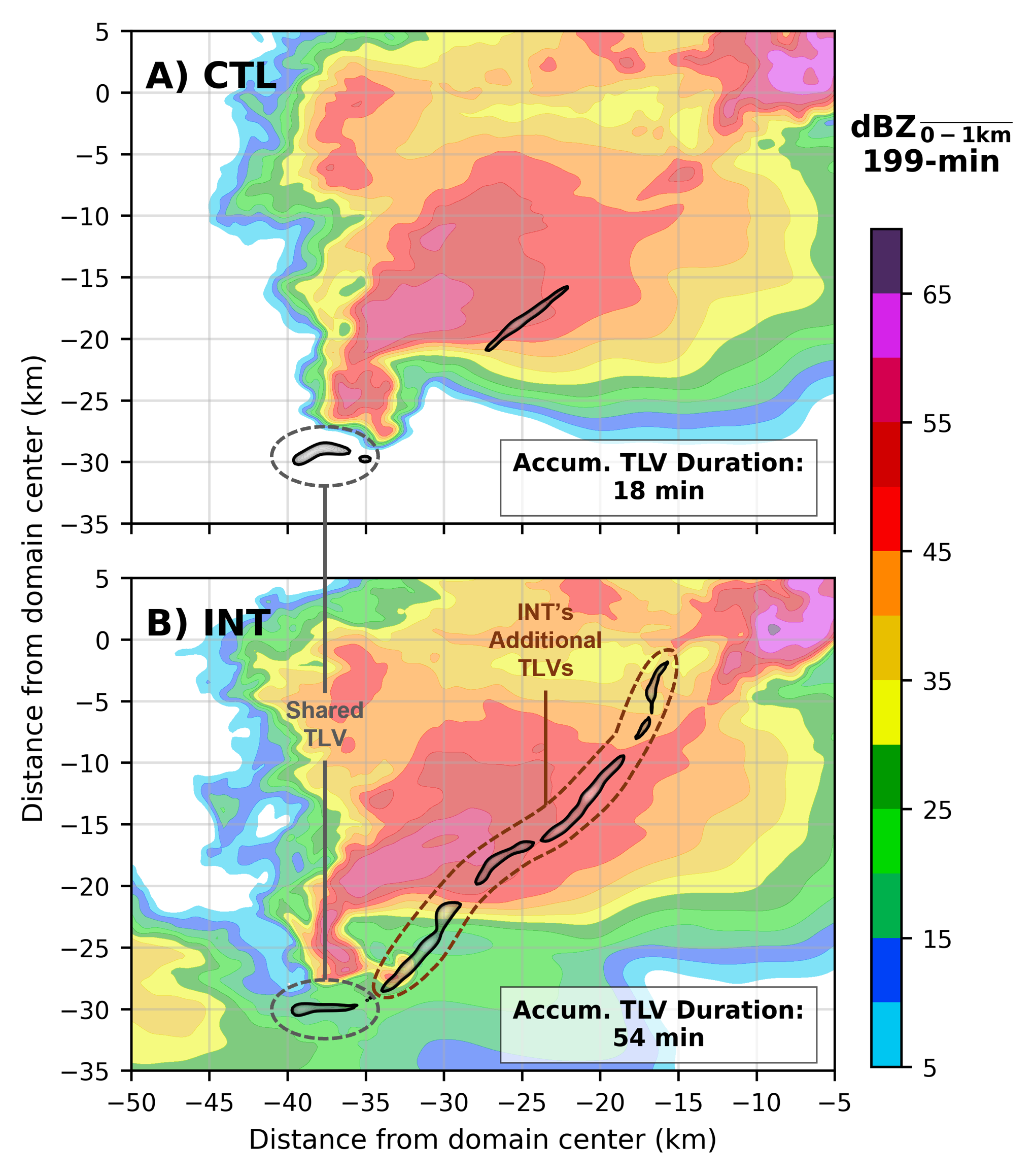
Storm interactions are known to induce changes in parent supercell storm behavior, including the production of tornadoes (e.g., Lemon 1976; Lee et al. 2006; Hastings and Richardson 2014; Fischer and Dahl 2023; Nixon et al. 2024; Werkema et al. 2025). Why this is true remains a question often asked but generally unanswered. To address this, idealized numerical simulations are used to investigate the full three-dimensional evolution of rear-flank storm interactions (which are often associated with increased tornado production, e.g., Nixon et al. 2024). Changes in storm behavior and tornado-like vortex production are tracked and physical mechanisms governing interaction outcome are investigated.
Simulated parent supercells subjected to rear-flank storm interactions exhibited dramatic increases in tornado-like-vortex (TLV) production. In one simulation, the parent supercell's accumulated TLV duration was 35 minutes longer than the control simulation. Rear-flank downdraft (RFD) behavior also changed markedly, becoming stronger and facilitating a state of inflow-outflow balance beneath the parent's low-level updraft. These changes in RFD behavior, perhaps the most important influence of the storm interaction, appear to be driven in part by both buoyancy and dynamic mechanisms.
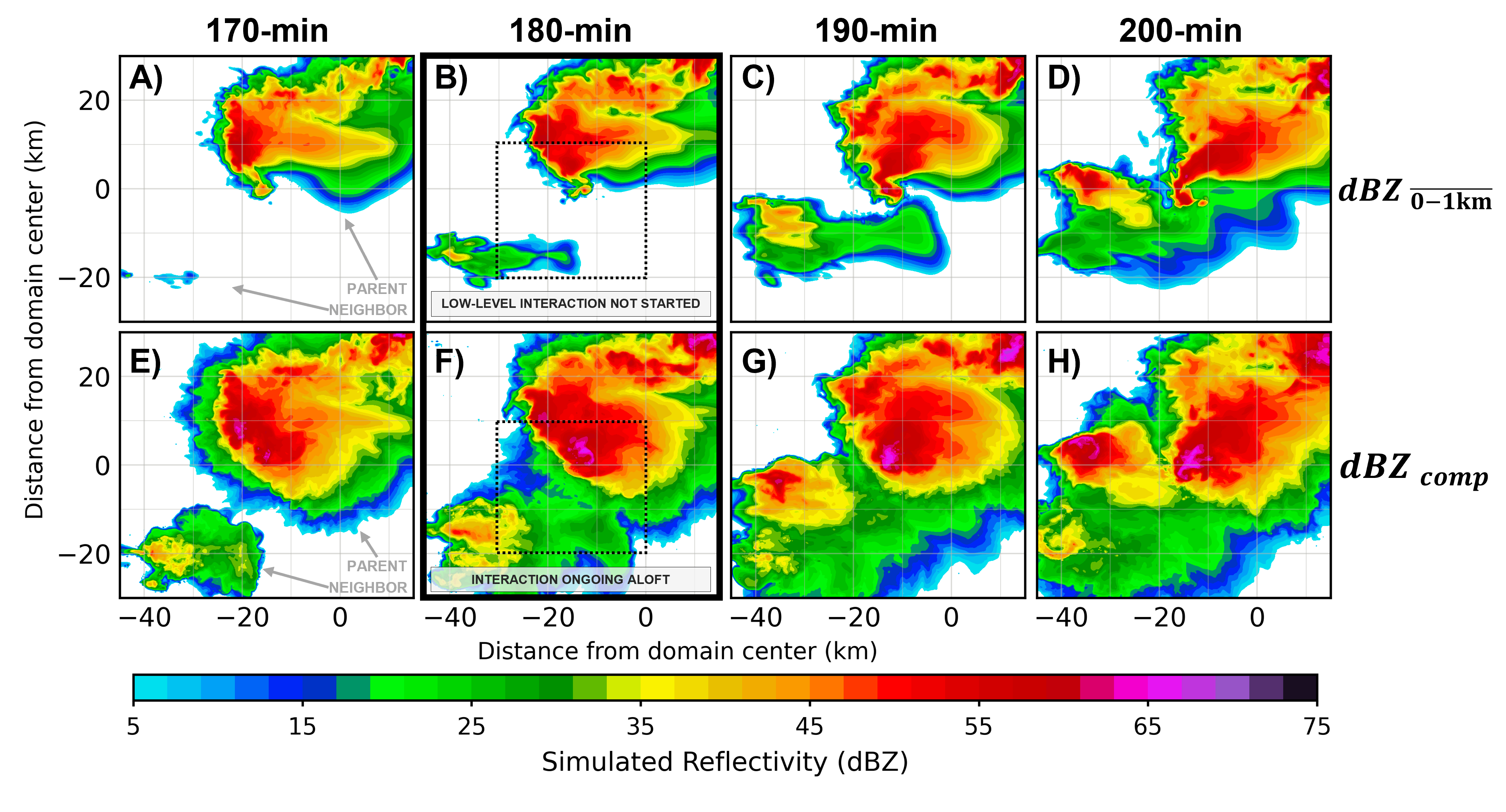
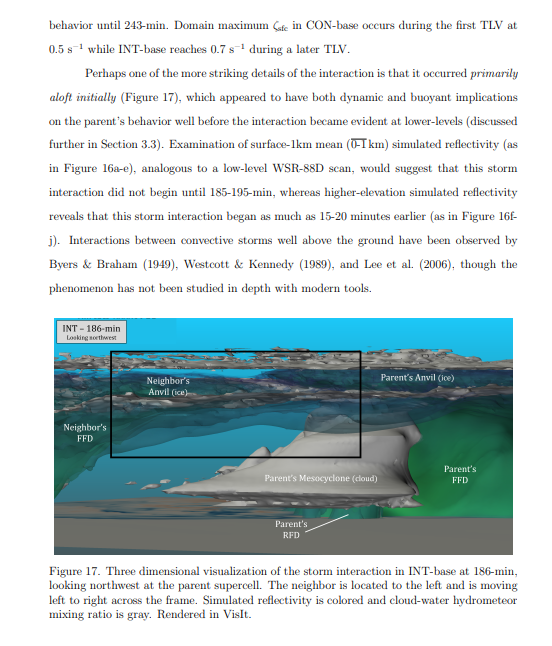
Among the most interesting aspects of the simulated storm interactions was the fact that storm behavior appeared to change before the interaction appeared to "begin" on low-altitude simulated reflectivity. Investigating this further revealed the obvious: the storm interaction was also taking place aloft and doing so before it appeared at lower altitudes (also observed by Byers and Braham 1949, Wescott and Kennedy 1989, and Lee et al. 2006).
The simulated storm interactions start aloft as much as 15–20 minutes before appearing in low-altitude reflectivity. Composite reflectivity may serve as a tool to help identify interactions occurring aloft and perhaps increase the lead time for anticipating interaction outcomes. The interaction starting aloft also played a major role in perturbing parent storm behavior through hydrometeor seeding and several dynamic mechanisms.
Master's thesis · University of North Dakota
Effects of a Rear-Flank Storm Interaction on Supercell Behavior and Tornado-like Vortex Development in Idealized Simulations - A Master's Thesis presented to the University of North Dakota Department of Atmospheric Science; July 2026
Thesis abstract
Observationally, storm interactions have been associated with changes in severe convective storm behavior and evolution, including the development and maintenance of tornadoes. In particular, the interaction of neighboring convection in or near the rear flank of a supercell thunderstorm has frequently been associated with tornadogenesis. Although statistical relationships for these changes in behavior have been established, the underlying physical mechanisms governing their evolution remain poorly understood, owing in part to limited spatial and temporal resolution of most observational datasets. Previous modeling efforts also lack the design and resolution required to sufficiently examine this problem. This study aims to complement and build upon existing findings by investigating the impact of auxiliary convection near the rear flank of a weakly tornadic supercell thunderstorm. Presented are two sets of numerical experiments, each consisting of five idealized model simulations. One experiment set simulates a single discrete "parent" supercell thunderstorm, while the other simulates the same "parent" subjected to a rear-flank interaction with an auxiliary "neighbor" cell. The interaction simulations reveal drastic changes in overall storm behavior and production of tornado-like vortices. The results suggest both buoyant and dynamic contributions to these changes and provide further evidence that rear-flank storm interactions can modulate overall storm behavior, which in turn modulates tornado development and maintenance.
- Gillett, K. J., 2026: Effects of a Rear-Flank Storm Interaction on Supercell Behavior and Tornado-like Vortex Development in Idealized Simulations. M.S. thesis, Dept. of Atmospheric Science, University of North Dakota, available at https://commons.und.edu/theses/13873/.
Poster
UND GRAD poster presentation
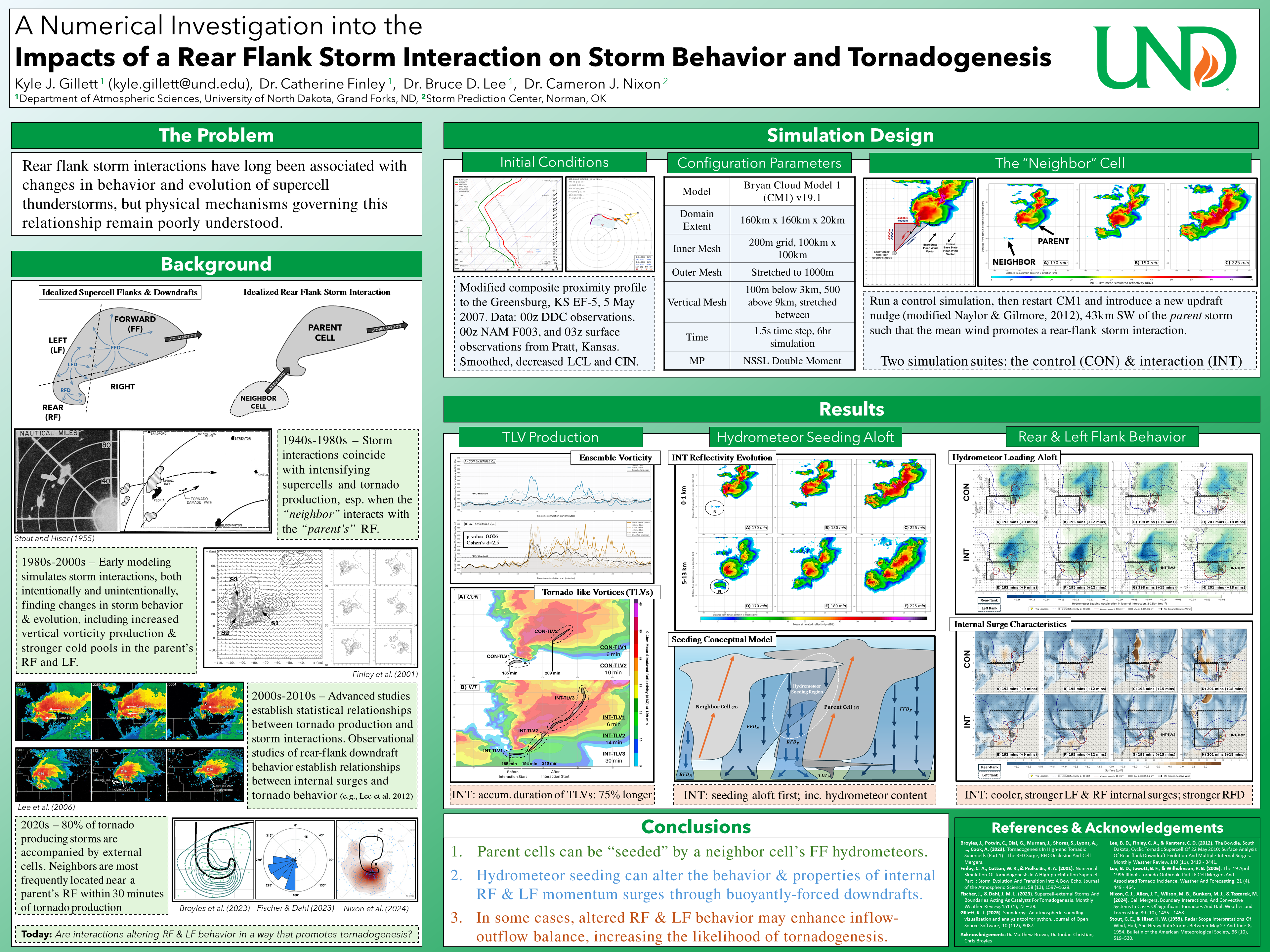
A poster featuring preliminary findings presented to the University of North Dakota Graduate Student Research Achievement Day, March 2026, Grand Forks, North Dakota (click to enlarge)
- Gillett, K. J., 2026: A Numerical Investigation into the Impacts of a Rear-Flank Storm Interaction on Storm Behavior and Tornadogenesis. Poster presented at the Graduate Research Achievement Day, University of North Dakota, Grand Forks, North Dakota.
Talks & posters
Presentations on this work
- Invited2026
Gillett, K. J.: Storm Interactions: Their Relationship with Storm Behavior and Tornadogenesis. Environment Canada Storm Prediction Centre Spring Change of Seasons Workshops, Winnipeg, MB, and Dartmouth, NS.
- Invited2026
Gillett, K. J.: Storm Interactions: Their Relationship with Storm Behavior and Tornadogenesis. NWS Grand Forks Change of Seasons Workshop, Grand Forks, ND.
- Oral2026
Gillett, K. J.: A Theory on the Relationship between Rear-Flank Storm Interactions, Storm Behavior, and Tornadogenesis. Symposium on Local Atmospheric Research, University of North Dakota.
- Oral2026
Gillett, K. J.: A Theory on the Relationship between Rear-Flank Storm Interactions, Storm Behavior, and Tornadogenesis. 29th Central Iowa NWA Severe Storms and Doppler Radar Conference, Ames, IA.
- Poster2026
Gillett, K. J.: A Numerical Investigation into the Impacts of a Rear-Flank Storm Interaction on Storm Behavior and Tornadogenesis. Graduate Research Achievement Day, University of North Dakota.